
Kansas Corrections Release Scope
Kansas correctional facilities form a statewide system operated by KDOC. They are not Trego County facilities, and the county Sheriff does not control their prison release records. A Trego County booking can lead to a KDOC commitment after sentencing. The Sheriff’s transfer entry closes the local custody episode, while KASPER and KDOC records track the later state imprisonment, supervision, and discharge.
Leaving a Kansas prison can lead to parole, conditional release, postrelease supervision, another custodian, or final discharge, depending on the sentence and event. Parole is a Prisoner Review Board decision for an eligible indeterminate sentence. Conditional release follows statutory credit rules. Postrelease supervision follows the prison part of many determinate sentences. Discharge is the point when the displayed KDOC sentence obligation ends.
| KDOC status | Meaning | What remains |
|---|---|---|
| Incarcerated | The person remains in state prison custody. | Check location and movements. |
| Parole | Prison release under supervision for an eligible sentence. | Parole conditions and office remain. |
| Conditional release | Statutory supervised release after retained credits. | Sentence supervision remains. |
| Postrelease supervision | The prison portion ended and mandatory supervision began. | Assigned supervision remains. |
| Discharged | The displayed KDOC sentence obligation ended. | Unrelated cases or duties may still exist. |
Confirm Kansas Corrections Release
KASPER, the Kansas Adult Supervised Population Electronic Repository, covers people sentenced to the custody of the Secretary of Corrections since 1980 who are incarcerated, under post-incarceration supervision, or discharged. KDOC says it updates daily except weekends. It does not cover every county-jail arrest, and it excludes inmates sent to Kansas under interstate compact.
- Accept the official disclaimer and search by last and first name or KDOC number.
- Narrow the match with middle name, birth date, conviction county, KBI number, facility, or supervision county.
- Read the current custody or supervision type before relying on any projected date.
- Review movements, conviction case, listed location, and supervising office.
- Treat parole or postrelease supervision as prison release with a continuing obligation.
- Treat discharged as the end of the displayed KDOC obligation, then verify the correct case.
An anticipated release date is prospective. Credits, disciplinary events, court changes, holds, and sentence structure can change it. A date in the past paired with an incarcerated location is not proof of release. Current location and status control until KDOC corrects or explains the record.
KDOC says a person record may also contain a photograph, conviction description, case number, facility movements, custody level, parole office, and disciplinary findings. Those details help distinguish similar names and trace a state movement. Use them to verify identity and status, not to copy unrelated personal details.
Kansas Release Search Fields
KASPER allows a detailed identity search. Use only the fields needed to confirm the correct person. Photographs can help, but KDOC cautions that an image database date may not be the date the photograph was taken. Name-only matching is weak, and a discharged state record does not explain a later county arrest.
| Search field | Use | Limit |
|---|---|---|
| Name and alias | Begin a broad match. | Common names require more proof. |
| KDOC number | Targets one state record. | Not a county booking number. |
| Birth date or age | Separates similar names. | Do not republish sensitive details. |
| Conviction county and case | Connects the state sentence to court. | May differ from current residence. |
| Supervision county and type | Finds parole, postrelease, or discharge status. | Data may lag. |
| Facility or location | Shows current placement. | Movements can update later. |
The official search screen presents the accepted fields and scope disclaimer.
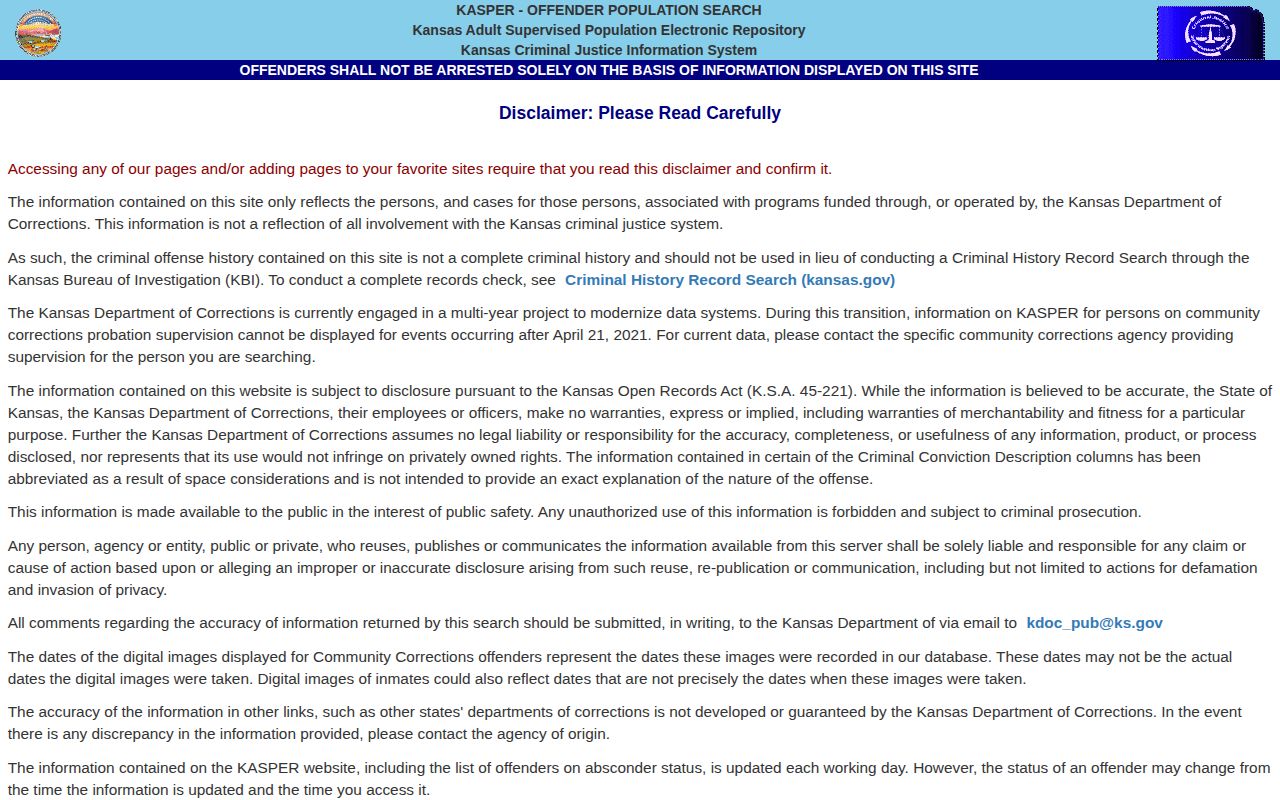
This state repository is the correct branch only after a KDOC sentence or supervision link has been established.
KASPER names generally remain after discharge unless a conviction is overturned, expunged, or affected by executive clemency. That persistence explains why the state record can outlast a short county roster display. A no-result can reflect lack of KDOC involvement, an identity mismatch, an excluded compact case, or later legal action.
KDOC Release Records Through GovQA
A public KASPER result can establish the current displayed status. For a durable record, request an existing custody movement, release or discharge entry, supervision status, supervising office, or available KDOC image through GovQA. Describe the person with a KDOC number and case details when known, and ask for a cost estimate before extensive work.
Kansas Department of Corrections714 SW Jackson Street, Suite 300
Topeka, KS 66603
General and Sentence Computation: 785-296-3317
Records Division: 785-746-7470
Email: KDOC_Pub@ks.gov
KDOC states that reasonable charges can reflect actual access, copying, and staff-processing costs. A response or estimate is provided within three business days, not necessarily final production. Ask for segregable public portions and the legal basis for any withheld part.
The KDOC GovQA records portal is the state request route.
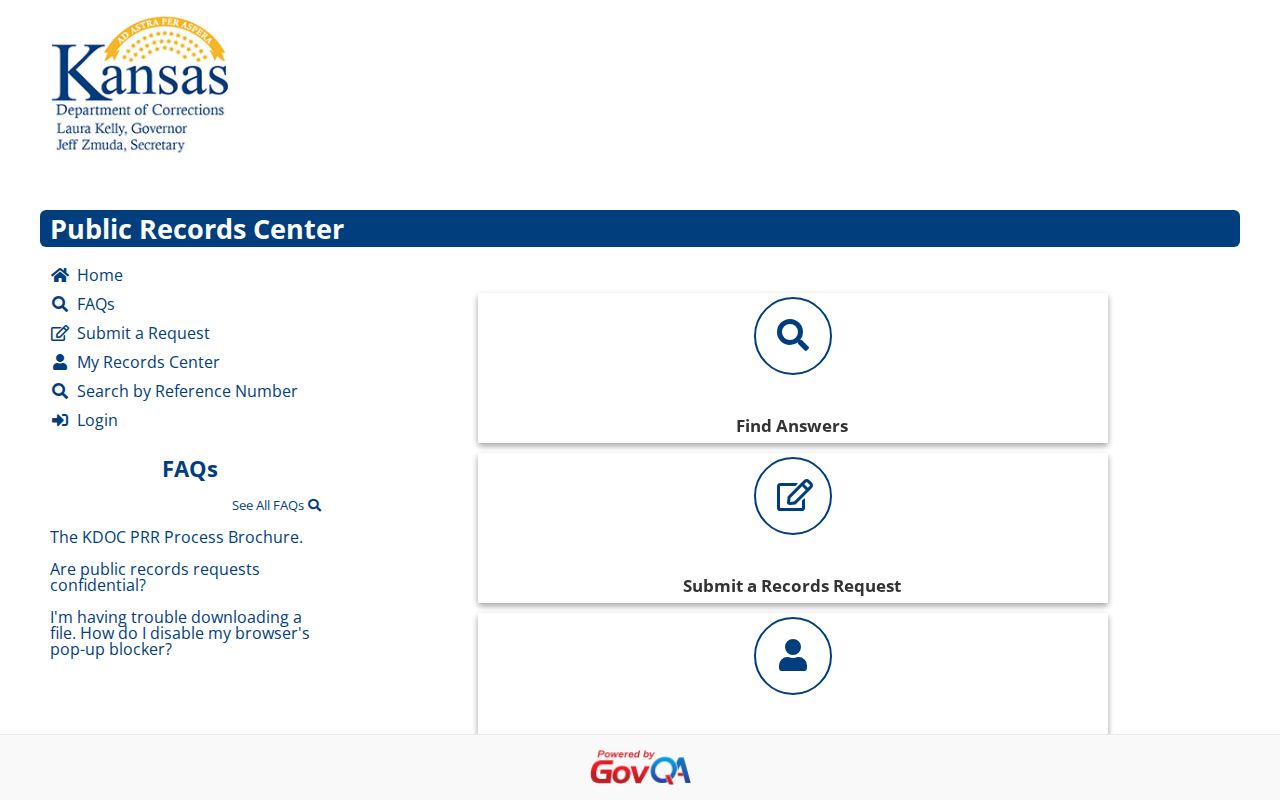
The portal supports a documented request when a KASPER screen alone does not provide the needed movement or discharge record.
Kansas public-record law permits a record to be open in part while medical, security, victim, juvenile, sealed, or expunged material remains protected. Ask KDOC to separate releasable fields. If access is delayed or denied, request the written reason rather than assuming the entire state custody file is closed.
Kansas Corrections Contacts
The main KDOC contact page routes sentence computation, records, parole, facilities, and other agency functions. A date question belongs with Sentence Computation, while a record request belongs with the public-record process. A listed parole office can verify a current assignment when KASPER shows supervision.
The official KDOC contacts page provides statewide routing.
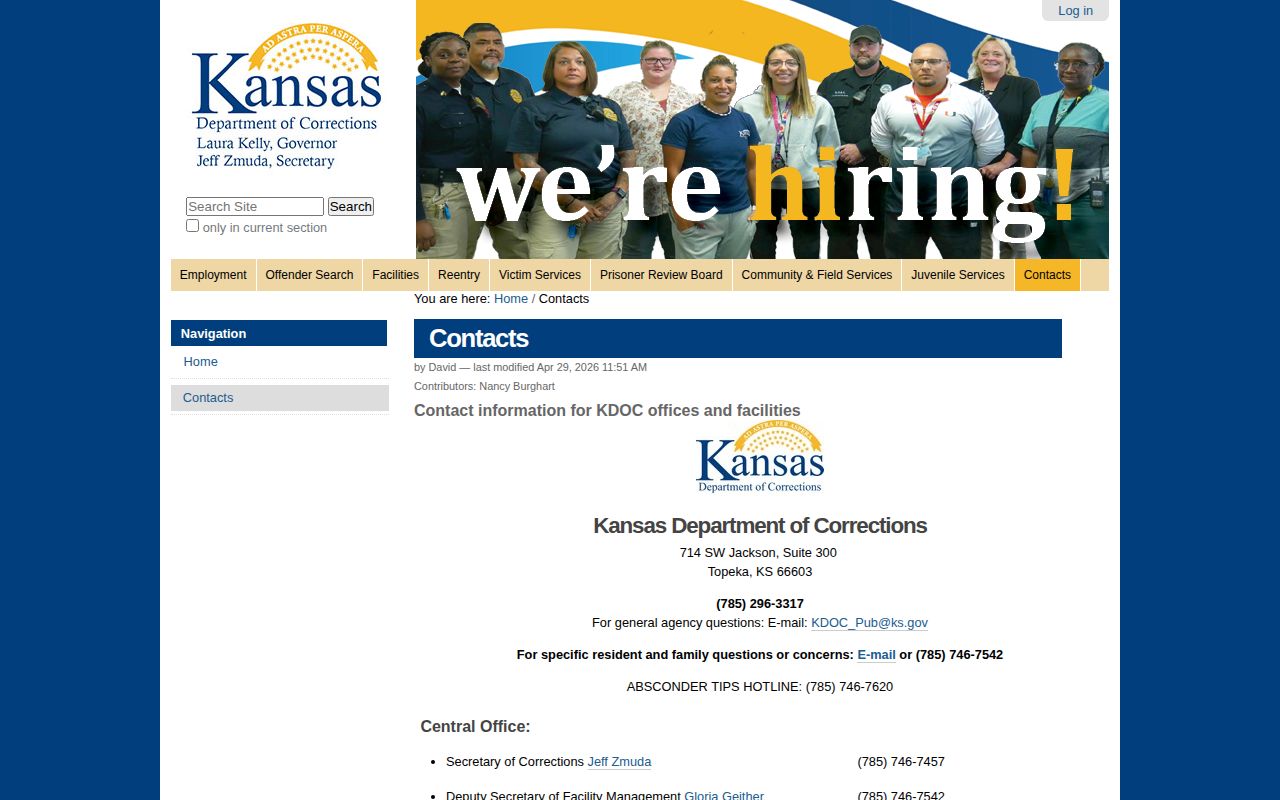
These contacts belong to a statewide agency in Topeka and regional offices, not to a prison located in Trego County.
Trego supervision is routed regionally through Hays. KDOC’s table places Trego under Northwest Kansas Community Corrections at 1011 Fort Street, Hays, with 785-625-9192. The 23rd Judicial District publishes another Hays address for the same named program, so call before visiting. Court probation and KDOC postrelease supervision are different paths.
KASPER provides separate parole and community-corrections absconder searches. An entry indicates an unresolved supervision-compliance status, not sentence discharge or the person’s exact physical location. Because the lists update on working days, urgent confirmation belongs with the supervising agency or law enforcement.
Kansas Prison Release Dates
KDOC calls its projected field “Anticipated release date.” The term signals that the date can change. K.S.A. 21-6821 provides current good-time and program-credit rules, while older offenses can fall under different statutes. Jail credit, consecutive or concurrent terms, withheld or forfeited credit, amended orders, and detainers can all affect timing.
Most non-off-grid crimes committed on or after July 1, 1993 use determinate sentencing. The person usually serves the prison portion and then enters mandatory postrelease supervision rather than waiting for discretionary parole. Older, off-grid, and special sentences can use a Prisoner Review Board process. A hearing list or favorable board outcome still is not the actual release timestamp. Confirm the movement and changed KASPER status.
K.S.A. 21-6615 makes the sentencing court’s jail-credit designation another key input. No sound estimate can be made without the judgment, offense date and category, sentence structure, credit record, and current program or disciplinary information. Specific computation questions go to 785-296-3317.
Trego Transfer to Kansas Corrections
When a Trego sentence results in commitment, obtain the Sheriff transfer entry and the court judgment first. Those records establish the local departure and legal authority. KASPER becomes useful after KDOC intake. Case number and conviction county can join the county court record to the correct state record.
If KASPER has no match, recheck spelling, aliases, birth data, and numbers. A person may never have entered KDOC, may fall outside repository scope, or may have an expunged or overturned case. KASPER also reports a modernization gap for some community-corrections probation events after April 21, 2021. A no-hit is a search limit, not proof of release or custody.
Identity should be supported by more than a name. Compare the KDOC number, birth details, photograph, conviction county, case number, movement dates, and supervision office. A discharged record from an old state case does not prove the outcome of a later Trego arrest. When case numbers differ, investigate separate sentences or bookings rather than combining them.
Expungement can also affect an older public trail. K.S.A. 21-6614 governs many conviction and diversion expungements, with different waiting periods and exclusions. A granted order can make affected records unavailable to the general public. Record absence after legal relief should not be described as proof that the underlying historical event never occurred.
For a confirmed prison release, preserve the KASPER observation date and timezone. Static instructions and office assignments can change, while dynamic status may update only on working days. A later correction should replace an earlier claim only after the new source, status, and case identity have been checked.
Note: Kansas VINE covers county jails and expressly excludes KDOC state-prison offenders, so it should not be used for this prison phase.