
Federal Inmate Release Scope
The Federal Bureau of Prisons operates federal correctional institutions nationwide. Its locator covers federal inmates from 1982 to the present. This is a separate custody system from the Trego County Detention Facility and Kansas Department of Corrections. A county arrest does not create a BOP record unless a federal process later places the person in BOP custody.
A federal sentence may end in release from a BOP institution followed by supervised release, which is court-ordered federal supervision. A person can also leave BOP because another authority takes custody. Conversely, a federal pretrial detainee managed by the U.S. Marshals Service may not yet appear in BOP at all. The agency and case stage determine the correct route.
| Federal stage | Best source | What it answers |
|---|---|---|
| Federal pretrial detention | Federal docket and USMS | Detention, bond, and custodian |
| BOP imprisonment | BOP locator | Current federal prison location |
| BOP release | Locator plus movement record | Date and BOP-specific status |
| Supervised release | Federal judgment and probation office | Continuing court supervision |
| Transfer to another authority | Originating transfer record | Who took custody next |
Search Federal Inmate Releases
The BOP inmate locator accepts a BOP register number, DCDC number, FBI number, INS number, or a name with optional demographic details. Results can show name, register number, age, race, sex, release date, and location. A register number is the strongest direct key when available.
- Open the official locator and choose number or name search.
- Use the register number when known; otherwise enter the exact legal name.
- Compare age and other displayed identifiers before selecting a result.
- Read the location and release-date fields together.
- Treat “Released” or “Not in BOP Custody” as departure from BOP only.
- Search the federal docket for the case disposition and any supervised-release term.
- Check another custodian when the case or transfer record identifies one.
BOP warns that First Step Act recalculation can temporarily make dates stale. A projected or listed date should not replace an actual changed status and movement record. Identity must also be matched to the correct federal case rather than inferred from a similar name.
The official federal locator presents the BOP-specific release route.
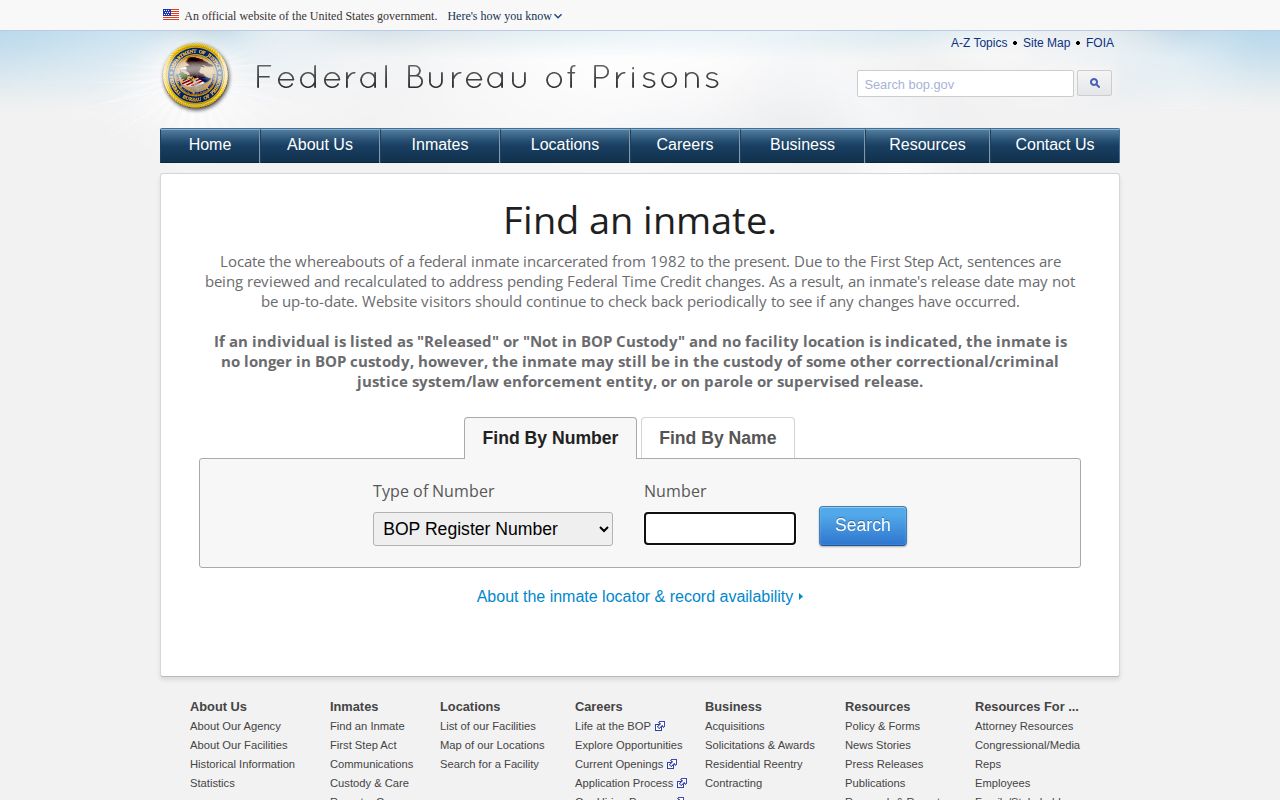
The displayed result closes only the BOP custody question and should be reconciled with the federal judgment and any later custodian.
A no-result also has limits. Recheck name order, suffixes, spelling, and every known agency number. A person may be in federal pretrial custody, may have a case outside the locator’s historical coverage, or may never have entered BOP. Use the docket and USMS route before concluding that no federal detention exists.
Federal Release Court Records
The federal docket provides the legal case history. Useful entries include detention, bond, dismissal, plea, sentencing, commitment, revocation, and supervised-release orders. A release order can authorize departure without recording the moment a holding facility completed it. Another warrant or detainer may also affect the outcome.
Federal supervised release is not the same as KDOC parole or Kansas postrelease supervision. It is imposed by the federal court and administered through the federal probation system. A BOP result can say “Released” while a federal supervision term continues. Read the judgment and later docket entries for duration, revocation, or discharge context.
If a person first appeared in the Trego roster, request the Sheriff transfer or release event. That record can show whether the U.S. Marshals Service took custody. The Trego County release records search explains the local record fields needed to connect the county episode to a federal case.
Case numbers create the strongest bridge. A Trego record may name a warrant or receiving agency, while the federal docket carries its own case number. Dates and identifiers should agree before the BOP result is attributed to the same person. Similar names and old records can otherwise produce a false match.
U.S. Marshals Custody Records
The U.S. Marshals Service commonly manages federal pretrial detention through local, regional, or contract beds. A person in that phase may not appear in the BOP locator because BOP designation has not occurred. The federal docket is the first source for detention and bond authority. USMS records can address agency custody or transfer details that do not appear in the public locator.
For a durable agency record, use the U.S. Marshals FOIA process. Identify the person, federal case, approximate dates, district, and the specific custody or transfer record sought. Request existing records, not a newly written explanation. Ask for segregable portions and the legal reason for any withholding.
A federal court order and a Marshals movement record serve different roles. The order states legal authority. The agency record addresses actual custody handling. Neither should be used to erase a simultaneous state or immigration hold.
Ask for a defined date range and record type. A custody movement, transfer, or release entry is more precise than a broad demand for every document. Federal exemptions can protect portions of a file. Request reasonably segregable material and retain the response date, office, and tracking information.
BOP Release Records and Contact
The locator is the public search entry point, not a full movement file. When the exact basis or destination matters, request the relevant existing BOP record through the federal public-record process and cite the register number. A focused request may seek the release date, release destination category, final facility, or transfer event to the extent maintained and releasable.
Federal Bureau of PrisonsNationwide federal correctional system
Public locator: BOP Inmate Locator
Coverage: federal inmates from 1982 to present
No BOP facility was found in Trego County
A release date can differ from the end of the entire federal sentence because supervised release follows imprisonment in many cases. “Not in BOP Custody” can also appear without a facility. Always retain the result’s register number and observation date so the same record can be matched later.
Federal locator dates can change during recalculation. A past date paired with a current facility should not be announced as a completed release. Confirm the live status, court record, and movement. For an event that already occurred, the actual departure record is stronger than an earlier projection.
Federal Versus Trego Release
The Trego Sheriff record controls the end of a Trego jail stay. BOP controls its own federal imprisonment record. The federal court controls the case disposition and supervised-release order. If the person passed through more than one system, build the sequence instead of substituting one source for another.
A useful sequence is arrest, county booking, federal transfer, pretrial custody, BOP designation, imprisonment, BOP release, and supervised release. Not every case includes every step. A BOP record unrelated to the Trego booking must not be used to explain the county event. Case number, dates, register number, and transfer agency help prove the connection.
- Register number
- The BOP identifier used to locate one federal record.
- Pretrial detention
- Custody before final federal case disposition, often managed by USMS.
- Supervised release
- Federal court supervision after the prison term.
- Detainer
- A request or authority that can lead another agency to take custody.
Federal Release and ICE Holds
A federal criminal release and an immigration custody event are separate. ICE can take custody after BOP or Marshals detention when lawful process applies. In that situation, “Released” from BOP does not mean community release. The originating transfer record and ICE locator are the correct next checks.
The ICE locator is oriented to current detention, not a permanent release history. Absence does not prove release. Search only with appropriate identifiers and never infer status from name, language, accent, or birthplace. If the federal docket indicates an immigration hold, preserve the exact wording and verify with the agency that created the transfer record.
Records from different federal stages should be kept in order. A docket may show the judge’s detention or release authority. A Marshals record may show transport and pretrial placement. BOP may later show designation, prison location, and departure. Federal probation records address supervised release. One source should not be stretched to cover a stage controlled by another office.
Observation dates matter. Locator status can change, and a sentence recalculation may alter the displayed release date. Save the register number, exact status text, source URL, and time checked. When the live record later differs, compare the federal docket and request the actual movement rather than treating the earlier display as permanent.
Federal records may withhold protected portions, but a focused request can still seek public and segregable fields. Identify the exact custody event, agency, case, register number, and date range. Ask for the final facility and receiving authority if transfer is at issue. A broad request without those limits can delay useful results.
No federal facility address should be invented for Trego County. A BOP result must name the actual institution or show that the person is no longer in BOP custody. The local link comes from a verified case or transfer, not from placing a national federal system inside the county.
Note: No federal prison was found in Trego County, so the county connection must come from a case, transfer, residence, or conviction record.